


Ask anyone about Alsace food and you will get the same six answers: choucroute, flammekueche, baeckeoffe, munster, bretzels and kougelhopf. They deserve the reputation. But they are barely the beginning. Fleischschnacka, onion tart, presskopf, streusel, berawecka — there is a whole side of Alsatian food that never leaves the region.
Part of what makes the food of Alsace so distinctive is the border it sits on. The region has passed between France and Germany several times, and the kitchen kept both: French technique and wine, German ingredients and dialect names. That is why a menu in Strasbourg reads like nowhere else in France.
We have traveled to Alsace dozens of times — mostly Strasbourg, plus more trips than we can count to the Christmas markets of Colmar, Riquewihr, Ribeauvillé and Kaysersberg. Plenty of time to eat our way through the menu. Here are the 22 dishes that define Alsace food, from savory classics to Christmas sweets, plus the wines and beers that go with them, where to eat them and what to take home.
✤✤✤
Short on time? Try these six: choucroute garnie, flammekueche, baeckeoffe, munster cheese, a bretzel and a slice of kougelhopf.
Savory Alsace food: 15 dishes to try
Alsatian cooking is food for sharing: generous, slow, built for long winters and shaped by centuries of German influence. These are the savory dishes to order at least once.
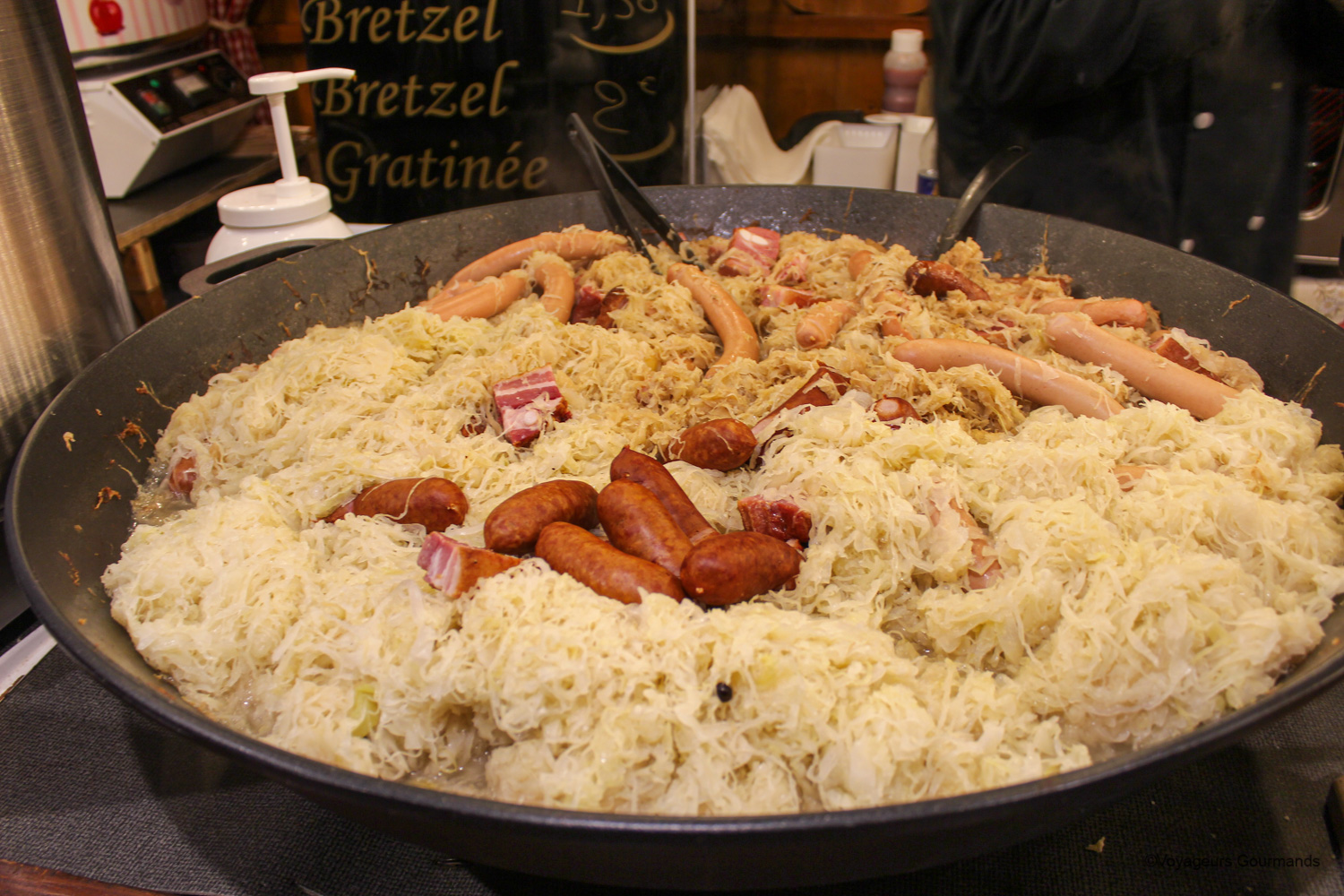
1. Choucroute garnie (Alsatian sauerkraut)
The dish everyone pictures when they think of Alsace. White cabbage is fermented, then slow-cooked with Riesling, juniper berries and bay leaves, and served as choucroute garnie: piled with Strasbourg sausages, smoked sausages, knacks, pork loin, smoked bacon and boiled potatoes.
One useful distinction: choucroute on its own means the fermented cabbage. What you order in a restaurant is the garnished version. There is also a seafood choucroute, made with smoked fish and beurre blanc, which is far lighter and a genuinely good option if cured meat is not your thing.
2. Flammekueche, also called tarte flambée
Say it “flam-uh-koosh”. It is a paper-thin base spread with fromage blanc or cream, scattered with thinly sliced onions and bacon lardons, then blasted in a wood-fired oven for a couple of minutes. The name comes from its origin as a test bake: it went into the bread oven to check the heat, and the flames licked the edges of the dough.
The classic version is still the best one, but you will also find it with mushrooms, spinach, raclette cheese, or sweet and flambéed with kirsch for dessert. In most places it is served all-you-can-eat: one comes out, you share it, another arrives, and it continues until somebody surrenders. Consider yourself warned.
3. Baeckeoffe
A celebration dish disguised as everyday food. Baeckeoffe means “baker’s oven”, and it is a casserole of three meats — pork, beef and lamb — marinated overnight in Alsatian white wine with onions, thyme and bay. Everything is then layered with potatoes and carrots in a glazed earthenware terrine, sealed shut with a rope of bread dough, and cooked slowly for several hours.
The name comes from the tradition behind it: women dropped their terrine at the baker’s on Monday, laundry day, and collected it cooked on the way home. Rich, deeply savory and perfect in winter.
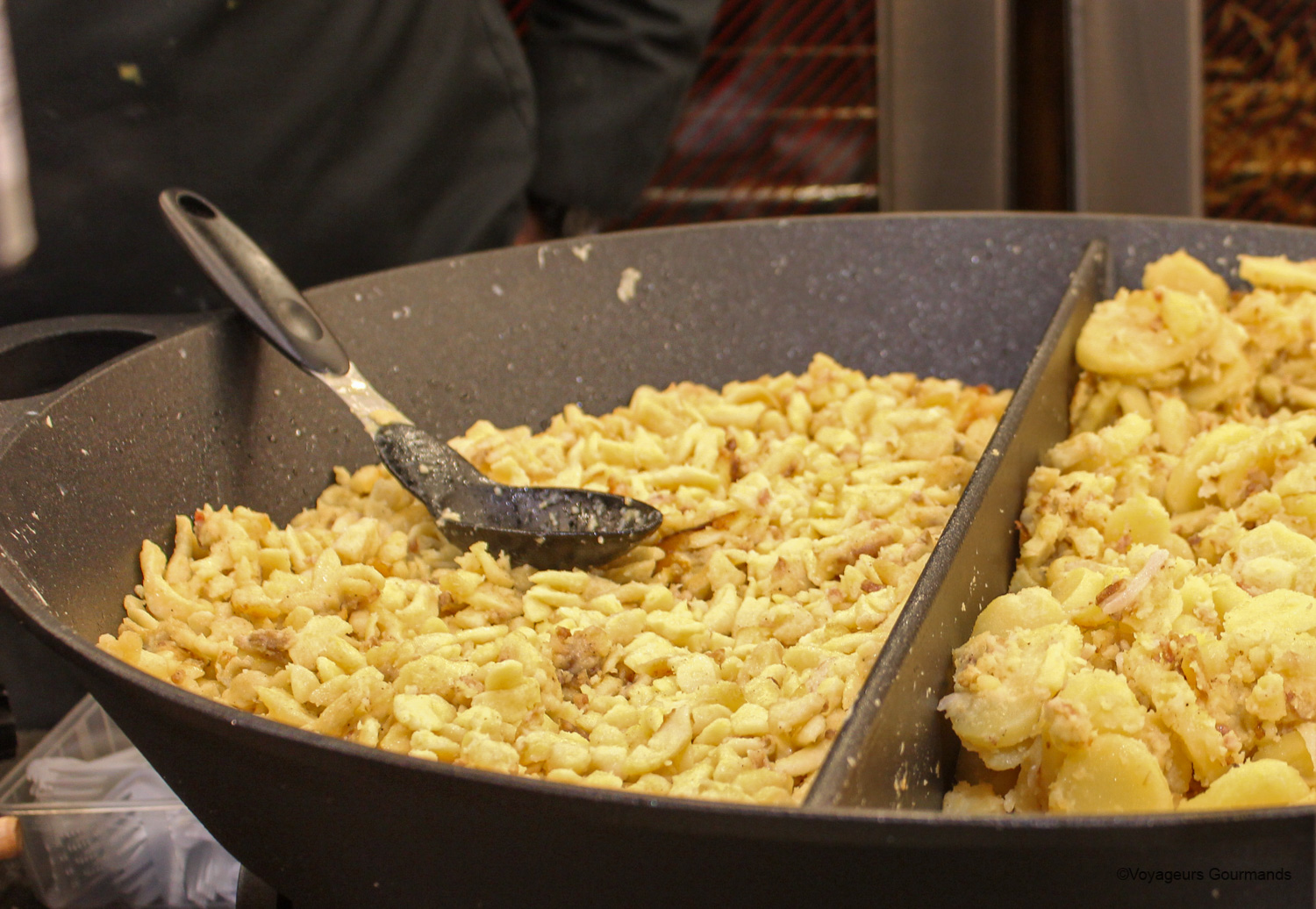
4. Spätzle
Small fresh egg noodles made from flour, eggs and water, pushed through a colander straight into boiling water. You will find them all over neighboring Baden-Württemberg too, which tells you a lot about the region’s food history.
They are the standard side for anything with sauce — coq au Riesling, baeckeoffe, game stews — but they also work as a meal in themselves, pan-fried in butter with bacon, crispy onions and grated cheese. That version is called Käsespätzle, and it is Alsace’s answer to mac and cheese.
5. Fleischschnacka
Here is the one nobody outside Alsace has heard of, which is a shame. Fleischschnacka means “meat snails” in Alsatian. Fresh pasta dough is rolled out, covered with leftover pot-au-feu beef chopped with onions and parsley, rolled into a log and sliced into thick rounds — hence the spiral.
The slices are then pan-fried or poached in broth and served with a sharply dressed green salad. It is a specialty of the Sundgau and the Mulhouse area, and a textbook example of old-fashioned zero-waste cooking.
6. Zewelwaï, the Alsatian onion tart
Shortcrust pastry, onions cooked down slowly until sweet, cream, eggs and sometimes bacon. Simple, comforting and on the starter menu of every winstub in the region. Traditionally it belongs to autumn and the grape harvest, eaten with a glass of the year’s new wine.
7. Coq au Riesling
The Alsatian take on coq au vin, made with white wine instead of red. Chicken simmers in Riesling with button mushrooms, shallots and cream, and arrives with spätzle or fresh Alsatian noodles. If you like neither cabbage nor cured meat, this is the easiest dish on the list to love.
8. Presskopf (head cheese)
Presskopf is a pork head terrine set in jelly, sliced and served with a shallot vinaigrette and plenty of parsley. It does not sound appealing written down, we know. But it is a winstub staple, and a good one is genuinely excellent. Worth ordering if you are the curious type.
9. Lewerknepfle (liver dumplings)
Dumplings made from pork or veal liver, poached in broth and served with fried onions, cabbage or salad. This is rustic weekday cooking: you will not see it on many restaurant menus anymore, but it is still very much alive in Alsatian home kitchens.
10. Cervelas salad
The Alsatian starter, and probably our favorite thing to eat there in summer: cervelas sausage cut into strips with gruyère, red onion, parsley and a mustard-heavy vinaigrette. Nothing complicated about it, and it disappears fast.
11. Bibeleskaes
Whipped fromage blanc sharpened with garlic, shallots and herbs — chives above all — served with jacket potatoes and sometimes grilled bacon. The name translates roughly as “chick cheese”. It is the classic Alsatian supper: light, cheap and surprisingly good.
12. Waedele and palette à la diable
Two brasserie plates you will see everywhere. Waedele is braised pork knuckle, usually served on a bed of sauerkraut. Palette à la diable is smoked pork shoulder brushed with mustard and honey, then roasted. Both are enormous. Come hungry.
13. Matelote du Ried
An easily forgotten specialty: a stew of river fish — pike, zander, eel, trout — simmered in a Riesling and cream sauce. Look for it in the Ried, the wetlands along the Rhine, and in fishing villages like Rhinau and Gerstheim.
14. Munster cheese
Munster is a soft, washed-rind cow’s milk cheese made in the Munster valley and the Vosges mountains. The smell is formidable — you will know the moment someone opens the fridge — but the taste is far gentler than your nose predicts.
Eat it on bread, sometimes with a sprinkle of caraway seeds, or melted over potatoes, on a munster flammekueche, or stirred into choucroute. It carries AOP status under the names Munster and Munster-Géromé.
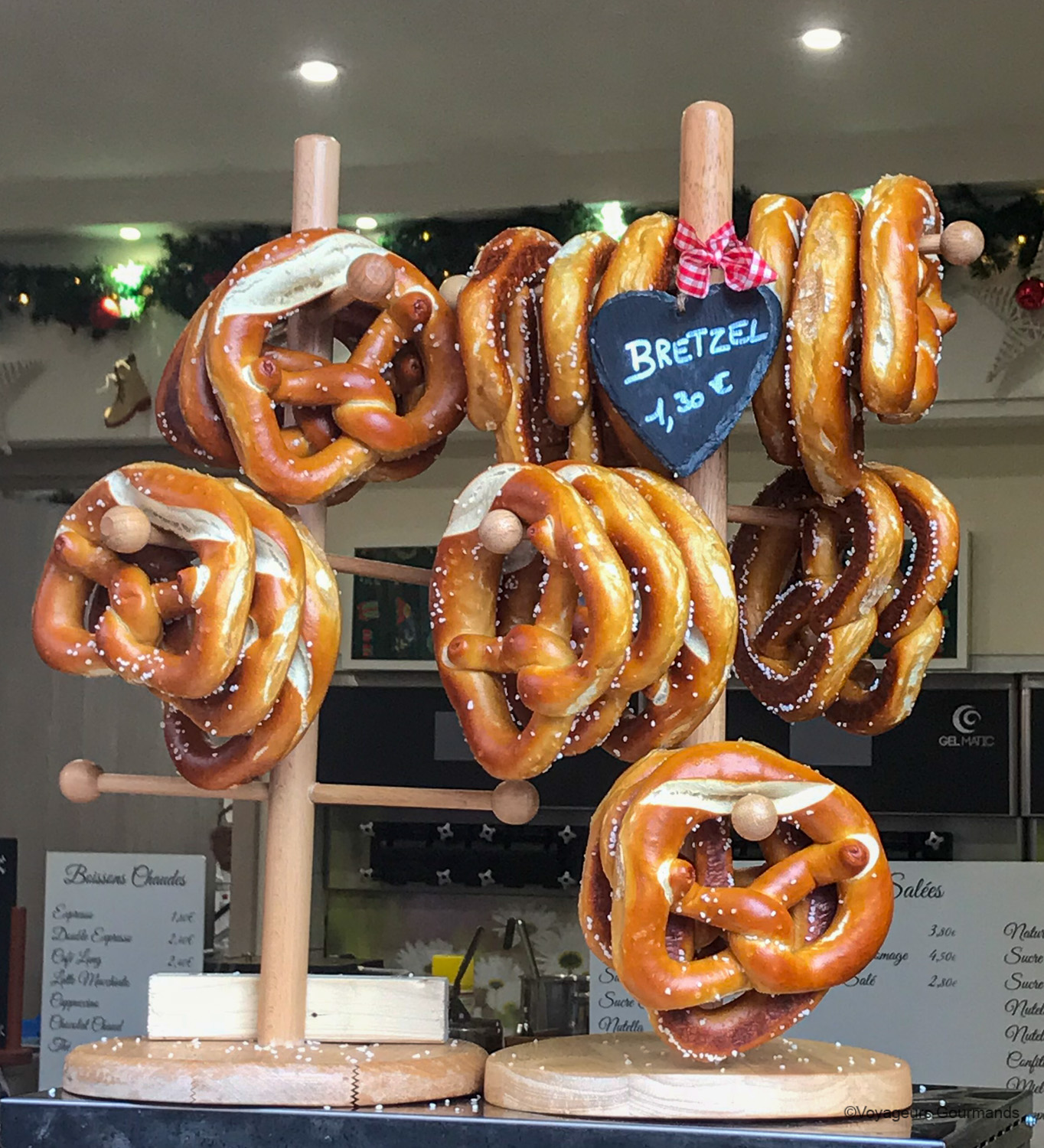
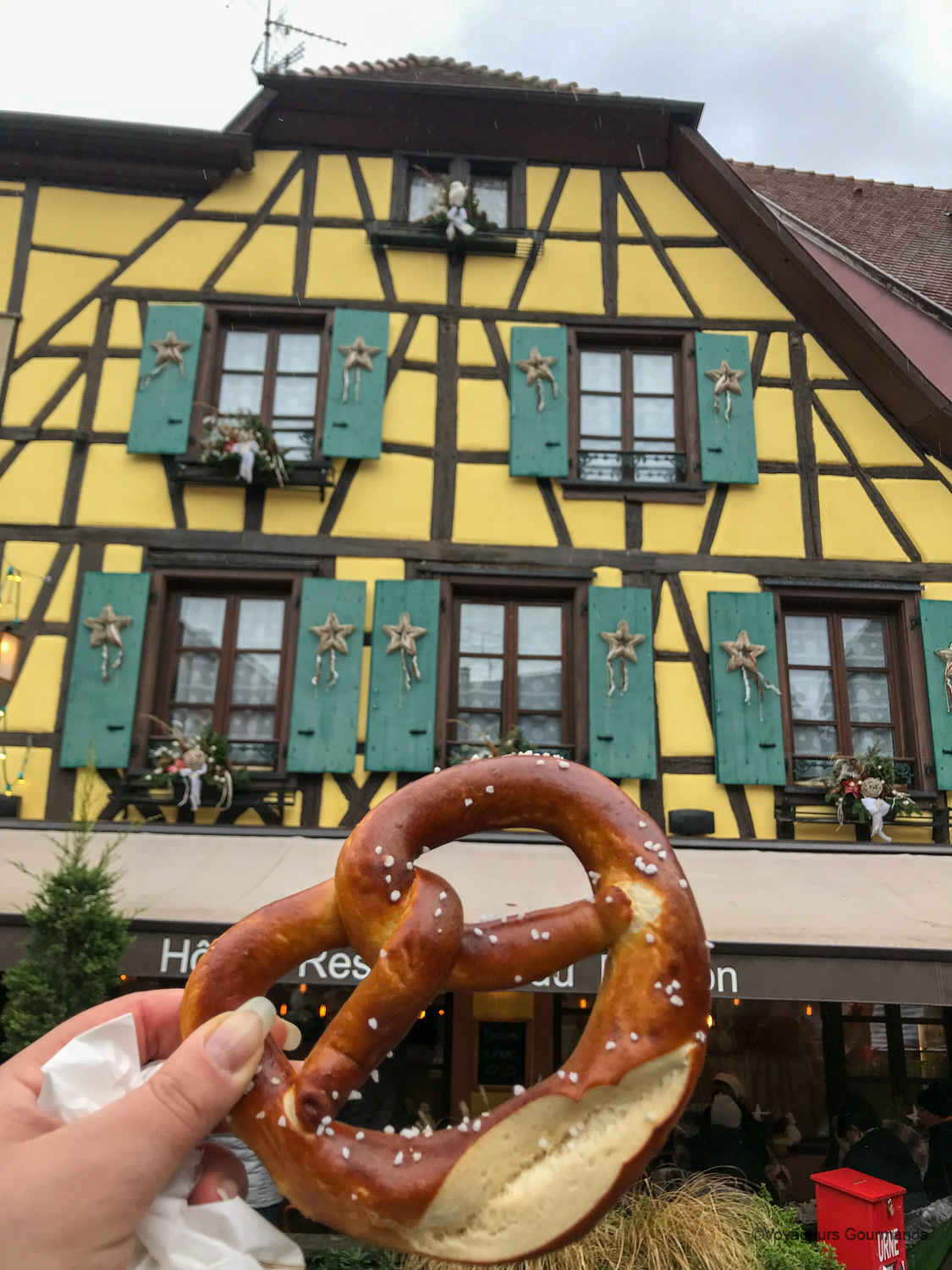
15. Bretzel
You already know the knot-shaped bread, and Alsace and Germany have been arguing over who invented it for a very long time. Flour, water, salt and yeast, dipped before baking in an alkaline bath that gives it that glossy brown crust and unmistakable flavor, then finished with coarse salt.
It is street food and beer food, and modern bakeries now sell endless variations: cheese, bacon, chocolate, even bretzel sandwiches.
Sweet Alsace food: desserts, cakes and Christmas treats
We have a theory that every sweet thing in Alsace is connected to Christmas one way or another. Read on and tell us we are wrong.
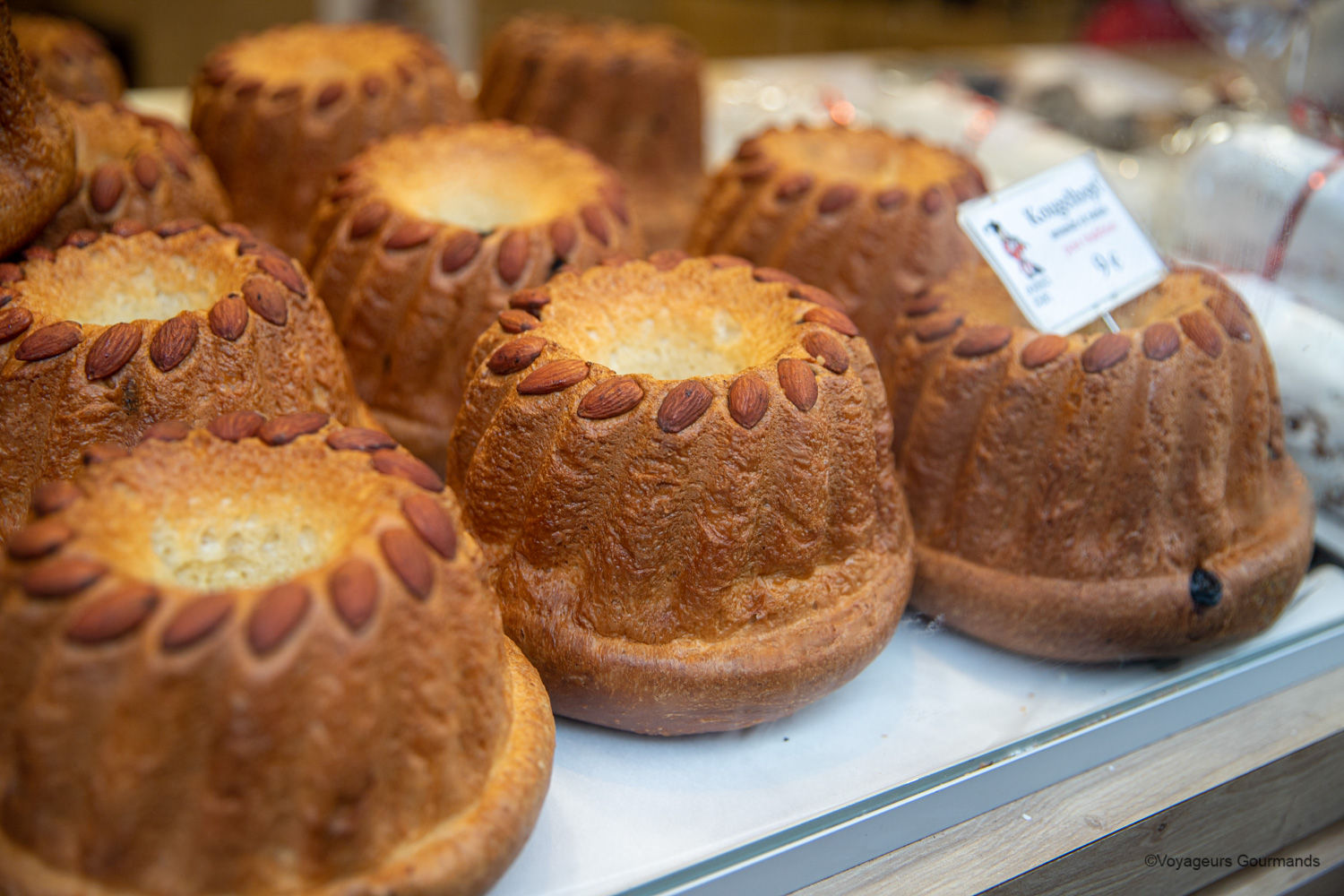
16. Kougelhopf
Kougelhopf is a brioche made with flour, eggs, sugar, butter, raisins soaked in kirsch and whole almonds. What defines it is the mold: a fluted crown of glazed earthenware that gives the cake its instantly recognizable ridged dome.
It turns up at breakfast, at afternoon coffee, and in a savory version studded with bacon and walnuts that is served as an aperitif with a glass of white wine. If you only try one, try both.
17. Pain d’épice (Alsatian gingerbread)
Gingerbread as we know it today took shape in Alsace, even though very similar honey breads existed in China more than a thousand years ago. It is made with flour, honey and a heavy hand of spice: cinnamon, nutmeg, ginger, anise and clove.
You will find it plain, sugar-glazed, or topped with candied fruit and almonds. It is sold all year, but let’s be honest, it mostly appears on holiday tables. Gertwiller, near Barr, is considered the gingerbread capital of Alsace.
18. Mannele
These plump little man-shaped brioches, dotted with chocolate chips or raisins, are eaten on Saint Nicholas Day, December 6. Every bakery in eastern France and across the German border has trays of them at that time of year. Children love them, and so does everyone else.
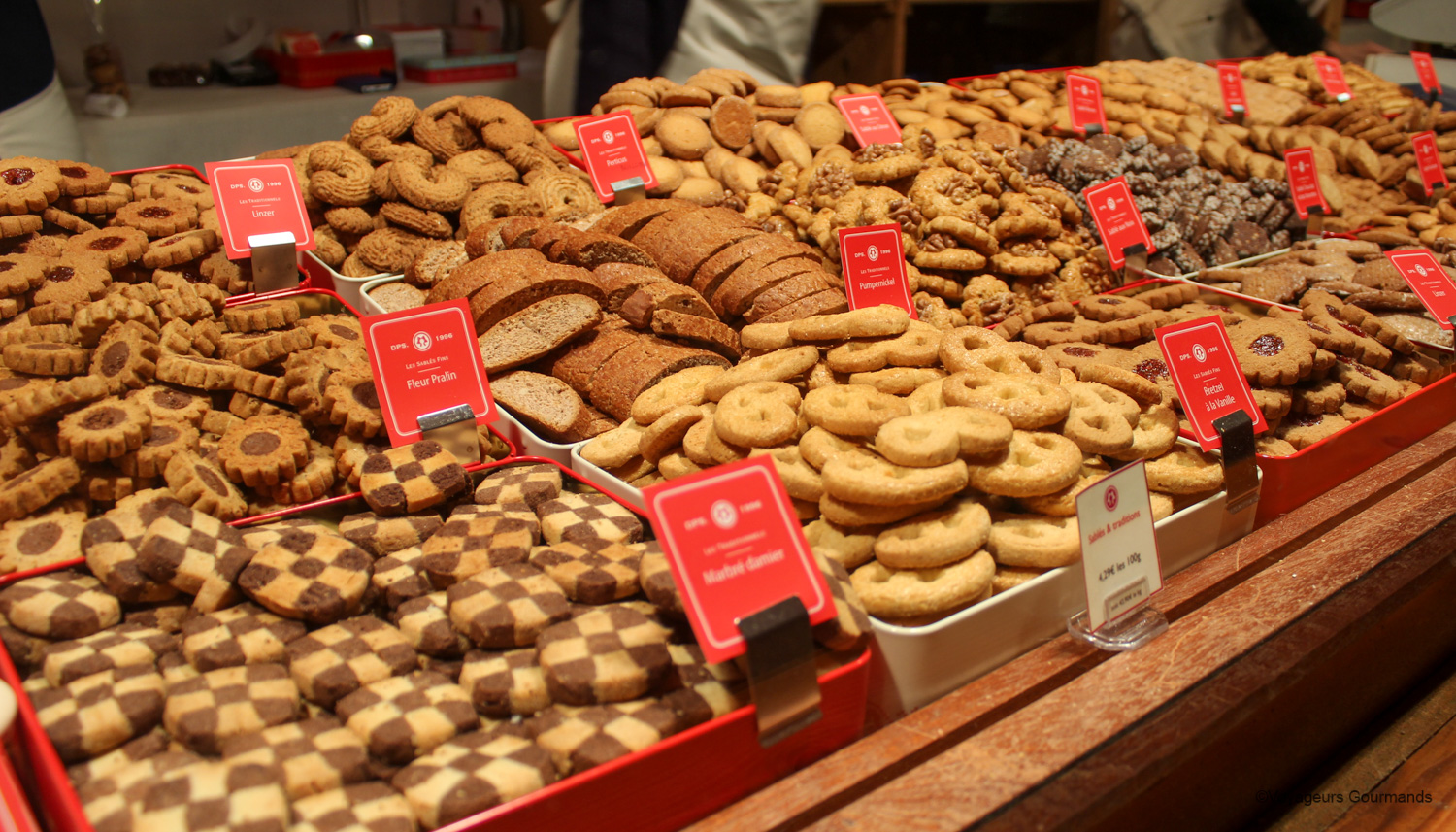
19. Bredele, the Alsatian Christmas cookies
Bredele are the Christmas cookies of Alsace, and there are dozens of kinds: butterbredele made with butter, schwowebredele with almonds and cinnamon, piped spritzbredele, anisbredele flavored with aniseed, honey-sweet leckerli. Every family has its own recipes, handed down through generations, and baking starts in late November so the tins are full by Advent.
This is the single best edible souvenir from the Strasbourg Christmas markets.
20. Quetsche plum tart
The quetsche, a small oval purple plum, is one of the emblematic fruits of the region. Baked into a tart on shortcrust or risen dough, dusted with cinnamon and sometimes set in a light custard, it is unmissable from late August through October. The mirabelle and blueberry versions are just as good.
21. Streusel
Streusel is not really a cake in its own right — think of it as Alsatian crumble cake: a brioche base buried under a thick layer of butter, flour, sugar and cinnamon crumbs. It comes plain or with fruit (apple, quetsche, blueberry) and is sold by the square in every bakery. The perfect afternoon snack.
22. Berawecka
Berawecka, or “pear bread”, is a dense holiday loaf packed with dried pears, figs, dates, candied fruit, walnuts and almonds, scented with kirsch and barely held together by a little dough. It is cut into thin slices and keeps for weeks. Think of it as the Alsatian cousin of Christmas pudding, best with a glass of ice wine or a cup of tea.
What to drink in Alsace
Alsace wines
Alsace is a major wine region with one peculiarity: bottles are sold under the name of the grape rather than the estate or the terroir, which is unusual in France and makes shopping much easier for visitors. The seven grapes are Riesling, Gewurztraminer, Pinot Gris, Muscat, Sylvaner, Pinot Blanc and Pinot Noir, the only red of the region.
- Riesling: dry, mineral, taut. The natural partner for choucroute and fish.
- Gewurztraminer: intensely aromatic, lychee and rose, often off-dry. Perfect with munster or foie gras.
- Pinot Gris: round and powerful, ideal with white meats.
- Muscat: dry and fruity, the aperitif of choice.
The finest plots are classified as Alsace Grand Cru, 51 named sites in total. If you want to see them, the Alsace Wine Route runs 170 km of flower-covered villages between Marlenheim and Thann.
Crémant d’Alsace
This one deserves its own section. Crémant d’Alsace is the best-selling sparkling crémant in France, made by the traditional method, mainly from Pinot Blanc, Auxerrois or Chardonnay. There is a rosé version too, made entirely from Pinot Noir. The value for money is excellent, so bring a bottle home.
Alsatian beer
Alsace is France’s brewing heartland by a wide margin, producing roughly 60% of the country’s beer. The big names cluster around Strasbourg: Kronenbourg in Obernai, Fischer and Meteor in Hochfelden, the latter being one of the oldest independent breweries in France.
Alongside the giants, around forty craft breweries have appeared in recent years (Perle, Uberach, Saint-Pierre, Bendorf). Two seasonal beers to look out for: bière de Mars, brewed at the end of winter, and bière de Noël, darker and spiced, poured at every Christmas market in the region.
Eaux-de-vie and schnapps
Kirsch (cherry), mirabelle, quetsche, raspberry, Williams pear: Alsace is fruit brandy country, distilled by small family producers, particularly in the Villé valley. They are served ice cold as a digestif, and they show up in a remarkable number of local recipes — kougelhopf, berawecka, bredele.
Vin chaud (mulled wine)
You cannot talk about drinking in Alsace without the mulled wine of the Christmas markets. Red wine, or white — the Pinot Blanc version is excellent — with cinnamon, star anise, citrus and sugar. There is also a widely available alcohol-free version made with hot apple juice.
Where to eat traditional Alsace food
The word to remember is winstub, literally “wine room”. It is the traditional Alsatian bistro: wood paneling, red-and-white checked tablecloths, elbow-to-elbow tables and a short menu of regional dishes. This is where you eat best, and usually for far less than in the tourist restaurants around La Petite France in Strasbourg.
A few practical tips:
- Skip the terraces on La Petite France and Cathedral Square. They are beautiful, but quality drops and prices climb.
- Book ahead on Friday and Saturday nights, especially during the Christmas markets, when the good tables fill up weeks in advance.
- Flammekueche is usually all-you-can-eat, which makes it the best value dinner for a group.
- Eat your big meal at lunch on a weekday: the plat du jour runs around €12–15, roughly half what the same dish costs à la carte in the evening.
What to bring home from Alsace
If you have space in your suitcase, here is what travels best:
- Bredele in a metal tin: they keep for weeks and make an ideal gift.
- Gingerbread from Gertwiller, plain or glazed, which lasts a very long time.
- A bottle of crémant or Gewurztraminer, bought straight from a grower on the Wine Route.
- A small flask of mirabelle or kirsch eau-de-vie.
- A berawecka, to bring out over the holidays.
- A glazed earthenware kougelhopf mold, so you can bake it at home. If you cannot find one locally, this model does the job well.
For the munster, pack an airtight container. And warn your travel companions. 😄
✤✤✤
That is our tour of Alsace food, from the winstub classics to the Christmas cookie tins. Which one are you trying first?
FAQ — Alsace food
Frequently asked questions about Alsace food
What food is Alsace famous for?
Choucroute garnie is the emblematic dish: fermented cabbage cooked in Riesling and served with sausages, smoked pork and potatoes. Alsace is also known for flammekueche, baeckeoffe, munster cheese, bretzels and kougelhopf.
Is Alsace food French or German?
Both, and that is the point. Alsace has changed hands between France and Germany several times, so the cooking combines French technique and wine with German ingredients, dialect names and portion sizes. Choucroute is sauerkraut, spätzle are German noodles, but they are cooked with Riesling and cream.
What is a winstub?
A winstub, literally a wine room, is the traditional Alsatian bistro: wood paneling, checked tablecloths, a short regional menu and local wine served by the pitcher. It is where you will eat the best food in Alsace, usually for less than in the tourist restaurants.
What is the difference between flammekueche and pizza?
The flammekueche base is much thinner and made without yeast, and the topping has nothing in common: no tomato or mozzarella, but fromage blanc or cream, onions and bacon. It also bakes far faster, in a wood-fired oven.
What should I drink with choucroute?
A dry Riesling, whose minerality cuts through the fat of the cured meats, or a local Alsatian lager. Both work. It is largely a matter of taste and of where you are, since beer tends to win in Lower Alsace.
What are the traditional cakes of Alsace?
Kougelhopf, gingerbread, streusel, quetsche plum tart, the mannele brioches of December 6, Christmas bredele cookies and berawecka. Alsatian baking is heavily shaped by the holiday season.
When is the best time to visit Alsace for food?
Late November to the end of December for the Christmas markets, bredele, mulled wine and Christmas beer. September and October for the grape harvest, onion tart and new wine. And all year round for choucroute and winstubs.