


Have you heard of Nazaré? It’s a seaside resort in central Portugal, regularly in the news for its gigantic waves and its surfers. It’s quite a small coastal town, but you can easily spend a day in Nazaré without getting bored. At the end of the article, we give you a few suggestions for fitting it into your itinerary: as part of your road trip in Portugal or as a stop between Porto and Lisbon.
✤✤✤
What to see and do in Nazaré
Lazing on the beach, taking the funicular for a jaw-dropping view, visiting chapels and churches, learning a little more about the town’s customs or tucking into a bola de Berlim… A lovely day ahead!


The beaches of Nazaré
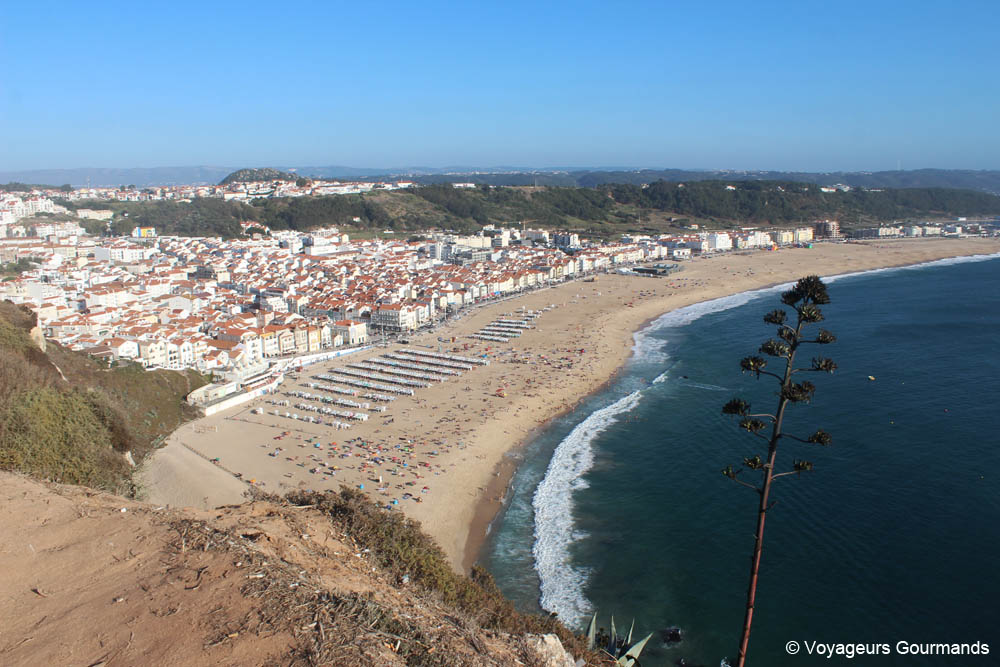
Of course, if you go to Nazaré, it’s for its ideal coastal location. In recent years, it has become one of the main seaside resorts on Portugal’s west coast. Three beaches can be reached from Nazaré:
Praia da Nazaré
The one you can walk to from the town centre: more convenient, but therefore busier. A paved promenade runs along Nazaré beach, perfect if you just want to stroll without settling down on the sand.
Praia do Norte
The beach with the gigantic waves, which you can come and watch between October and March (sometimes April). The best spot to see them is Nazaré lighthouse. Be careful, though: the risk of accidents is very high, and this place has seen a few tragic stories.
Praia da Areeira
A little further away, less easy to reach, and therefore quieter.


Wander through the fishermen’s quarter
This summer, we took the time to stroll through the fishermen’s quarter, in the lower town, between the beach and the centre. It’s a maze of narrow lanes lined with little white houses, with washing drying at the windows. This is also where you’ll come across the famous grannies offering rooms to passers-by (the women in seven skirts, on the other hand, are mostly up in Sítio, near the sanctuary). A lovely walk to get a feel for the soul of Nazaré, away from the bustle of the seafront!
The municipal market
A few streets from the beach, the municipal market (Mercado Municipal) is the ideal place to take the pulse of the town. Under the market hall, the stalls overflow with freshly caught fish, fruit and vegetables, cheese and dried fruit. Go in the morning, when it’s at its liveliest… and the choice is best! It’s also a chance to taste (or take home) some dried fish.
Take the funicular
The town is built both on top of its cliffs and at their foot. A funicular, the Ascensor da Nazaré, takes you up to the Sítio quarter for €2.50 one way (August 2025 price). Up there, of course, you’ll have a superb view over the whole bay, thanks to another pleasant promenade and many viewpoints (miradouros). In this historic part of town, you’ll find the sanctuary and the chapel of Our Lady of Nazaré, several souvenir shops, a view over Praia do Norte and access to the fort. On this square, you’ll see women wearing traditional dress, made up of no fewer than seven skirts!


The Miradouro do Suberco
As you step out of the funicular, you’ll come straight to the Miradouro do Suberco, Nazaré’s most famous viewpoint. Perched more than 100 metres above the ocean, it offers a postcard view over the beach, the rooftops of the lower town and the whole bay. We recommend coming back at the end of the day for the sunset! And if you fancy a quieter view, head over to the Pederneira viewpoint too, in the oldest part of town, perched on another hill.


The Sete Saias (seven skirts)
As you wander around Nazaré, you’ll notice that some women wear a rather unusual outfit. They dress in several skirts layered on top of each other, traditionally seven of them. This tradition is, of course, linked to the sea: women waited for hours for their fishermen husbands or sons, and used their skirts to protect themselves from the cold. As for the number seven, it comes from the seven virtues, the seven days of the week, the seven colours of the rainbow, or from biblical, mystical or magical passages mentioning this number. To find out more about these traditions, the small Dr. Joaquim Manso Museum, in Sítio, is dedicated to the history and life of Nazaré’s fishermen.


The Sanctuary of Our Lady of Nazaré
The main church stands on one of the most important squares in town. It houses a wooden image of a Black Madonna, brought from Mérida in 711, whose story is told in the legend of Nazaré. The sanctuary is actually made up of the church, the chapel and the grotto of Nazaré.


The Chapel of Our Lady of Nazaré
Also known as the Ermida da Memória (hermitage of memory), this small square chapel was built in 1182 over a grotto. During the Muslim conquest of the Iberian Peninsula, an image of the famous Black Madonna breastfeeding Jesus was found here. Today, it has kept its beautiful Portuguese azulejos, as well as a window overlooking the sea.


São Miguel Arcanjo Fort and Nazaré Lighthouse
We only saw it from a distance, as it’s just a small red lighthouse inside the fort. Its position is still impressive, though, and if you want to come and watch the big waves, this is the best spot. If you go, don’t miss the stag sculpture (Veado), which recalls the legend of Nazaré, or the small exhibition inside the fort featuring the boards of big-wave surfers.

The fort on the far left on the cliff + the funicular on the right
Eat fish and a bola de Berlim
We tell you about restaurants in the practical section a little further down. In the meantime, we can tell you that the bolas de Berlim sold on the beach are delicious, and here, unlike in northern Portugal, you’ll find them in every flavour. And of course, Nazaré being a fishing town, the local specialities are mostly fish-based: grilled sardines and fish, caldeirada (a kind of Portuguese fish stew) and above all dried fish (peixe seco). It’s a real local tradition: horse mackerel, sardines or small rays are split open, salted and then dried in the sun on large racks set up right on the beach. You’re bound to come across them as you stroll along the seafront. And check out our article on Portuguese specialities too!


See the giant waves and go surfing
As I mentioned at the start of the article, Nazaré is famous for its huge waves. Surfers from all over the world come here to try to tame them. If you surf, you must know this spot well :). If you’re not a surfer but curious to see this phenomenon, you can come between October and March (or even April, depending on the year). The view from Nazaré lighthouse is perfect. However, these big waves are also dangerous, sometimes exceeding 20 metres. Be careful not to get too close.
In fact, the world record for the biggest wave ever surfed was broken in this Portuguese town… several times! In November 2017, Rodrigo Koxa broke Garrett McNamara’s record by surfing a huge 24.38 m wave. That record fell in turn, again in Nazaré: on 29 October 2020, German surfer Sebastian Steudtner rode a 26.21 m wave, certified by Guinness World Records in 2022.
View this post on Instagram
A day in Nazaré: practical information
How long do you need to visit Nazaré?
One day is enough to see the highlights of Nazaré: the beach and its promenade, the funicular up to Sítio, the sanctuary, the chapel, the fort and the lighthouse… not forgetting a bola de Berlim! If you’re short on time, half a day is enough to go up to Sítio and admire Praia do Norte from the fort. In summer, allow 2 days if you also want to enjoy the beach. And if you’d like to explore the surrounding area, 3 to 4 days will let you take day trips around Nazaré (we share our ideas a little further down).
As for the season, summer is ideal for enjoying the beach, and October to March for seeing the giant waves. Nazaré is also famous for its carnival, one of the liveliest in Portugal, and for the Nossa Senhora da Nazaré festivities in September.
Where to stay?
It’s not really something people do in the villages and towns Alcino and I come from (Viana do Castelo and Braga), but here you’ll see lots of Portuguese mums and grannies at their windows “luring” you in by offering you um quarto, a room! 🙂 This happens even in the middle of August, so you’re unlikely to be stuck for somewhere to sleep, and it helps the locals earn a bit of money. 🙂 But if you’d rather book in advance, have a look at Booking!
Where to eat?
On our last visit, in August, we had lunch at A Deriva restaurant, right on the beach. And we don’t recommend it: the food wasn’t good and the service was very slow… At a push, for a drink or an ice cream facing the sea, but no more than that!
Our tip: pick out 3 or 4 well-rated restaurants before you come, and book, especially in summer. Here are the ones that come up most often in recommendations (we haven’t tried them yet):
➺ Taberna d’Adélia (Rua das Traineiras): fish and seafood, listed in the Michelin Guide. They show you the fish before cooking it!
➺ A Celeste (Avenida da República): on the seafront, known for its salt-crusted fish and its cataplana.
➺ A Tasquinha: a small, traditional family-run place, popular with locals and visitors alike.
➺ Pangeia: more upmarket, on the heights of Pederneira, with a lovely ocean view.
How to get there?
The car is still the best option: Nazaré is about 1h30 from Lisbon and 2 hours from Porto by motorway. It’s also a great stop on a Portugal road trip, between Porto and Lisbon or on a loop around the centre of the country, with Óbidos, Alcobaça and Batalha just a few kilometres away. Without a car, it’s doable but less convenient: the train doesn’t stop in the town itself, but at Valado dos Frades station, a few kilometres away, from where you’ll need to take a bus or a taxi. The easiest option is the direct coach from Lisbon (allow around 2 hours).
How to fit it into a Portugal itinerary?
There are several options depending on your stops, the length of your stay and what you want to see in Portugal.
➺ You can choose Nazaré as a stop between Porto and Lisbon. Just like Coimbra, Fátima or Batalha, it all depends on your interests.
➺ On a 10- or 15-day loop around the North or on an itinerary starting from Lisbon.
➺ On a loop focused on the centre of the country.
Around Nazaré
You can also stay longer in town and spend 3 to 4 days exploring the surrounding area. There are plenty of places of interest around Nazaré:
➺ The Sanctuary of Fátima
➺ Batalha Monastery
➺ Alcobaça Monastery
➺ Óbidos
➺ Peniche fort, its beaches and the Berlengas archipelago.
More suggestions in our dedicated article on central Portugal.
✤✤✤
We hope you enjoyed the story of our day in Nazaré and that it has made you want to discover this lovely coastal town! Had you heard of Nazaré?
FAQ: things to do in Nazaré in one day
Frequently asked questions are here!
How long do you need to visit Nazaré?
One day is enough to see the highlights: the beach and its promenade, the funicular up to Sítio, the sanctuary, the chapel and the lighthouse. Half a day is enough to go up to Sítio and see Praia do Norte. Allow 2 days if you want to enjoy the beach in summer, and 3 to 4 days to explore the surrounding area (Fátima, Batalha…).
What are the best things to do in Nazaré in one day?
Stroll along Nazaré beach, take the funicular for the view over the bay from the Sítio viewpoints, visit the sanctuary and chapel of Our Lady of Nazaré, walk to São Miguel Arcanjo fort and its lighthouse, spot the women in seven skirts and try a bola de Berlim on the beach.
When can you see the giant waves in Nazaré?
The giant waves break on Praia do Norte between October and March, sometimes until April. The best viewpoint is São Miguel Arcanjo fort, home to the lighthouse. Be careful: these waves can exceed 20 metres and the site is dangerous.
How do you get to Nazaré without a car?
The train doesn’t stop in Nazaré itself but in a neighbouring town, from where you need to take a bus to the centre. Coaches also link Nazaré to major cities such as Lisbon. The car is still the most practical option, especially on a road trip.
What food is Nazaré known for?
As it’s a fishing town, people mostly eat fish: grilled sardines and fish, caldeirada (a kind of fish stew) and dried fish (peixe seco), dried in the sun on racks set up on the beach. Not forgetting the bolas de Berlim sold on the beach!
